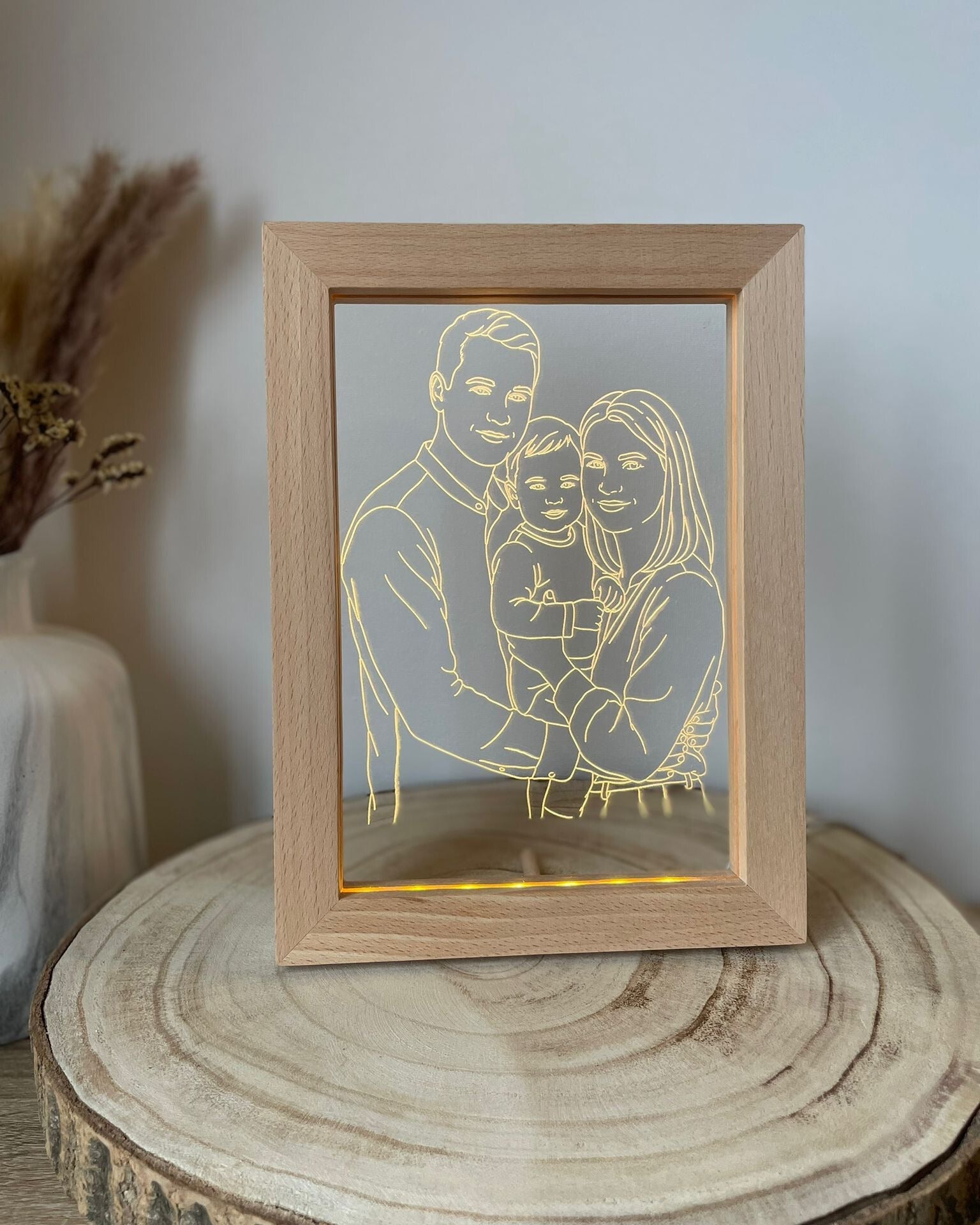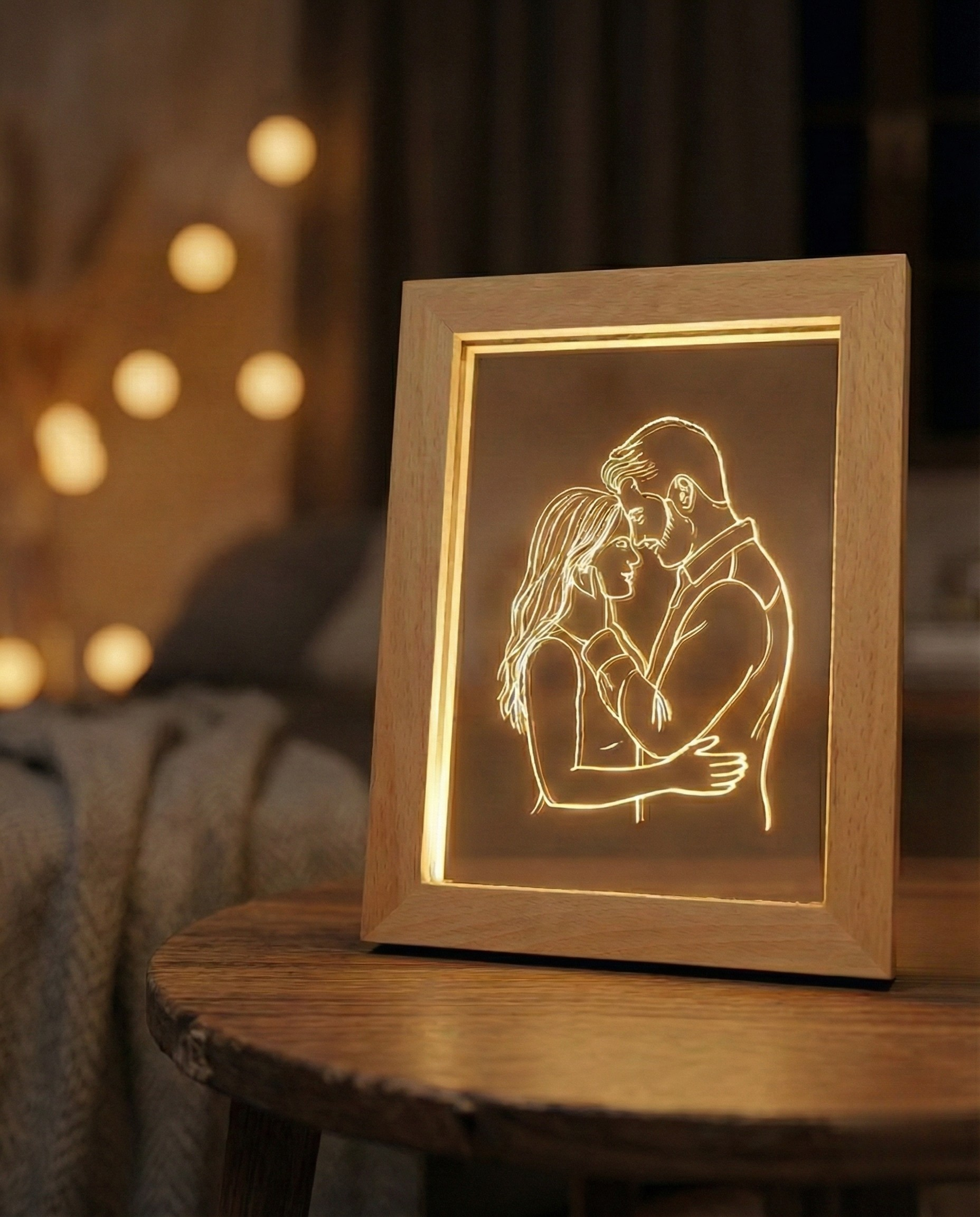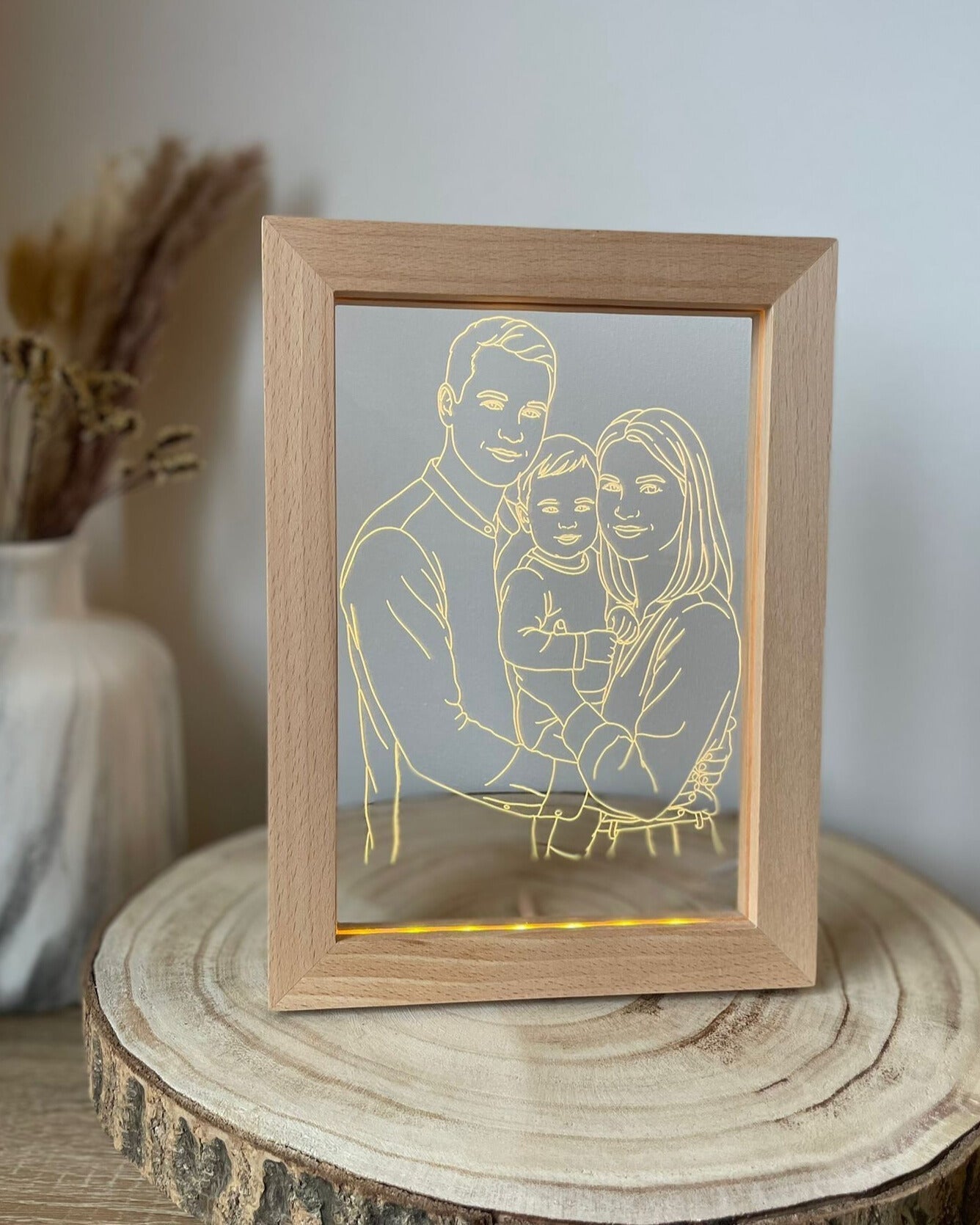
How to Choose the Best Photo and Composition for StoryFrame™
The best photo for StoryFrame™ is sharp, well lit and centred on one or two clearly visible subjects. Faces, profiles or defining outlines should be easy to recognise, while the background should not compete with the people or pet you want to preserve.
StoryFrame™ — Framed Line Art Lamp turns your uploaded photograph into clean line art, laser-engraves the design on a 23 × 17 cm clear acrylic panel and displays it with a solid wood USB LED base. It belongs to AtaNova’s personalised lamp collection and is made to order in our Antwerp atelier. Choosing the right photo gives the line art a clearer composition and makes the Design Proof easier to review before engraving.
The Quick Photo Checklist
Choose a photograph that meets as many of these points as possible:
- The main subject is sharp and in focus.
- Faces, profiles or important outlines are clearly visible.
- The image has balanced, even lighting.
- The subject is not hidden by deep shadow, hair, hands or another person.
- The background is simple or visually separate from the subject.
- One or two main subjects receive most of the visual attention.
- The photograph has enough space around the subject for a balanced crop.
- Heavy filters, strong blur and very low-resolution images are avoided.
A professional photograph is not required. A clear phone photo can work well when the subject is easy to see and the composition is not crowded.
Why Photo Composition Matters for a Line Art Lamp
StoryFrame™ does not print the original photograph onto the product. AtaNova uses the photograph as the source for a simplified line art design. The recognisable shapes, expressions and outlines matter more than background detail, colour or photographic effects.
A good composition helps the important parts of the image remain clear when they are translated into engraved lines. A crowded photograph may contain many details that look understandable on a screen but become too small or visually dense when simplified. A clean photograph gives the main subject more space and usually creates a stronger framed result.
Choose One Clear Visual Focus
Before uploading a photograph, decide what the StoryFrame™ should be about. Is the important part a couple, one person, a parent and child, a family moment or a pet?
The best image usually has one obvious answer. The viewer should immediately understand which person, relationship or subject carries the memory. When several people, objects and background elements compete for attention, the composition can feel less focused.
For one person
Choose an image where the face, profile or characteristic pose is clearly visible. A close portrait or a well-framed upper-body photograph often gives the subject enough visual presence without relying on small details.
For a couple
Choose a photograph where both people are similarly clear and neither face is hidden. Wedding portraits, engagement photographs and natural side-by-side moments can work well when the couple forms one balanced visual unit.
For a parent and child
Look for a photograph where the relationship is visible through the pose: an embrace, joined hands, eye contact or a clear side-by-side position. The connection between the subjects should remain understandable even after unnecessary background detail is removed.
For a pet
Choose an image where the face, ears and main outline are easy to distinguish. A characteristic sitting pose, profile or direct portrait is usually clearer than a distant action photograph.
How Many People Should Be in the Photo?
One or two main subjects normally create the cleanest StoryFrame™ composition. A small family group may also work when every face is clear, the people are close together and the photograph has enough resolution.
As the number of people increases, each face occupies less space in the final 23 × 17 cm composition. Small facial features may therefore become less prominent when the image is converted into line art. For a larger group, choose the clearest available photograph and make sure nobody important is hidden behind another person.
Use Lighting That Keeps Faces and Outlines Visible
Balanced lighting is more useful than dramatic lighting for photo-to-line-art conversion. The subject should be visible without large areas disappearing into shadow or bright highlights removing important facial detail.
- Choose a photo where the eyes, face shape and profile can be seen.
- Avoid photographs where the main subject is strongly backlit.
- Avoid deep shadows that hide one side of the face.
- Use natural or even indoor light when it keeps the subject clear.
- Do not rely on a filter to repair an image that is already blurred or dark.
The original photograph can be warm, cool, colourful or black and white. What matters most is whether the subject remains visually clear, because the finished design is created from lines rather than reproduced photo colour.
Keep the Background Simple
A plain wall, open sky, calm interior or softly separated background can make the main subject easier to isolate. A busy background is not automatically unusable, but it should not merge with the face, hair, clothing or pet outline.
Check the edges of the subject carefully. Dark hair against a dark wall, patterned clothing against a patterned background or several overlapping objects can make the outline less distinct. When possible, choose the version of the photograph with the cleanest separation between subject and surroundings.
Leave Enough Space for a Balanced Crop
The StoryFrame™ acrylic panel measures 23 × 17 cm, so the final design must be arranged within a defined framed area. A photograph does not need to match those exact proportions, but it helps when the subject is not cut too tightly at the top, sides or bottom.
Choose an image with some breathing room around the people or pet. This gives the composition more flexibility during the Design Proof stage. Very tight crops can limit how the subject is centred, while extremely distant subjects may contain too little visible detail.
Choose Expression and Pose Before Perfect Photography
The strongest StoryFrame™ photo is not always the most formal or technically polished image. The subject still needs to be clear, but the expression, gesture or relationship is what makes the finished piece personal.
A natural wedding moment may be more meaningful than a studio pose. A child looking at a parent may communicate more than a perfectly centred family portrait. A pet’s familiar expression may matter more than a neutral photograph. Start with the emotional value, then select the clearest version of that moment.
How to Add Text Without Overloading the Composition
StoryFrame™ can include optional short engraved text on the wooden base when that option is selected. The image should remain the main visual element, so use text to identify or complete the memory rather than explain it in full.
Suitable short text can include:
- Two names
- A wedding or anniversary date
- A short dedication
- A brief memorial line
- A family name
Short wording is easier to balance and read. Check all names, dates and spelling carefully when reviewing the Design Proof.
Photos to Avoid When a Better Version Is Available
- Images with strong motion blur
- Very low-resolution or heavily compressed photographs
- Faces hidden by shadow, sunglasses, hair, hands or other people
- Very distant group photographs with small faces
- Heavy filters that remove natural facial detail
- Busy compositions with no clear main subject
- Photographs cropped tightly through important parts of the face or body
If the meaningful moment exists in several photographs, compare them at full size and choose the one with the clearest faces and outlines rather than the one with the strongest filter or most dramatic background.
What Happens After You Upload the Photo?
- Upload your chosen photograph. Add any selected short text and choose 3-Color Light or RGB.
- AtaNova prepares the composition. The main subject is transformed into clean line art and arranged for the 23 × 17 cm acrylic panel.
- You receive a digital Design Proof by email. Review the crop, subject placement, line art, names, dates and spelling.
- Approve or request a small adjustment. Engraving begins only after the final design is approved.
- Your StoryFrame™ is made in our Antwerp atelier. The approved artwork is laser-engraved on clear acrylic and paired with the solid wood USB LED base.
StoryFrame™ is made to order and delivered with tracking in 3–5 business days from the order date. For the complete ordering process, see How It Works.
Final Decision: Which Photo Should You Upload?
Upload the photograph that combines emotional meaning with visual clarity. Prefer one or two clearly visible subjects, balanced lighting, recognisable faces or outlines, a calm background and enough space for a considered crop.
When two images carry the same memory, choose the clearer composition. When one image matters far more emotionally, choose that image if the main subject can still be recognised. The Design Proof gives you the opportunity to check how the selected photograph has been translated before engraving.
Create your StoryFrame™ from a favourite photograph, or browse more photo, date and name-based designs in the AtaNova personalised lamp collection.
Frequently Asked Questions
What photo works best for StoryFrame™?
A sharp, well-lit photograph with one or two clearly visible subjects and a simple background usually creates the cleanest line art composition.
How many people should be in the photo?
One or two main subjects normally give the clearest result. A small group may also work when every face is visible, the people are close together and the photograph has enough resolution.
Can I use a pet photo?
Yes. Choose a pet photograph where the face, ears and main outline are clearly visible. Portraits, profiles and characteristic sitting poses usually provide a clear visual focus.
Does the background matter?
Yes. A simple or well-separated background helps the main subject remain clear. Avoid backgrounds that merge with the face, hair, clothing or pet outline.
Will I see the composition before engraving?
Yes. AtaNova sends a digital Design Proof by email before engraving. You can review the crop, placement, line art and personalised text and request a small adjustment before approval.
Can I add text to StoryFrame™?
Yes, when the optional text engraving is selected. A short name, date, dedication or message can be engraved on the wooden base. Short wording usually creates the most balanced result.