Article: Do You Need the Exact Time for a Star Map? Date, Time & Location Explained
Do You Need the Exact Time for a Star Map? Date, Time & Location Explained
You do not always need the exact minute to create a personalised star map, but the most reliable time available will give the design the closest match to the moment you want to preserve.
The date identifies the day, the location establishes the viewpoint on Earth, and the time determines how the sky was oriented at that point during the day or night. If the exact time is unknown, the right approach is to use the closest trustworthy estimate rather than inventing a precise minute.
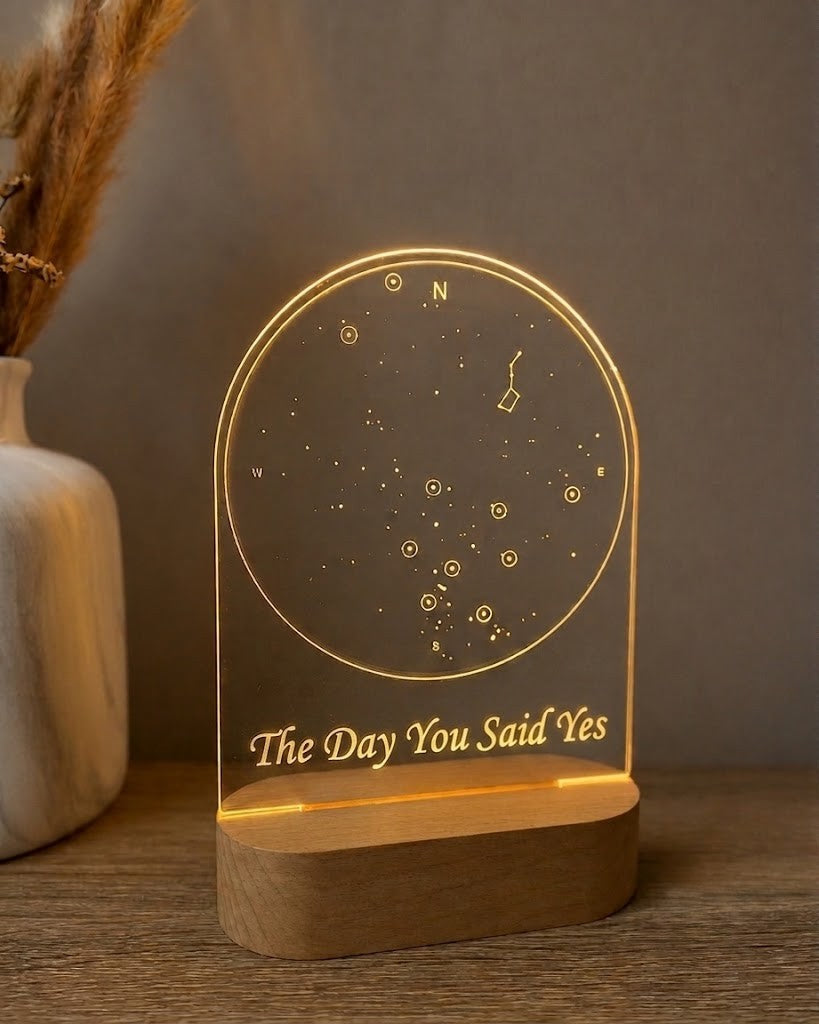
The NovaMap™ Star Map Lamp turns a chosen date, local time and location into a personalised night-sky design, laser-engraved on clear acrylic and illuminated from a solid wood LED base.
Does the exact time matter for a star map?
Yes, the time matters because the apparent position and orientation of the night sky change as the Earth rotates. A star map calculated for early evening will not be identical to one calculated for the same place several hours later.
However, this does not mean that a NovaMap cannot be created when the exact minute has been forgotten. The purpose is to represent the chosen moment as faithfully as the available information allows.
The exact time is especially useful when:
- The moment was a birth and the birth time was recorded
- A proposal happened at a known hour
- A wedding ceremony had a documented starting time
- The event happened close to midnight
- The hour itself has emotional meaning
When the hour is not central to the story, a well-supported approximate time can still create a meaningful and coherent design.
What changes when the time changes?
Changing the time does not create a completely unrelated sky, but it changes how the sky is positioned for the chosen location.
A difference of several minutes will normally be less significant than a difference of several hours. The greatest care is needed when the moment occurred near midnight, because both the time and the calendar date may become relevant.
For example, a celebration may have started on Friday evening but the important moment may have happened after midnight on Saturday. In that situation, the correct entry is the date and local time of the specific moment being preserved, not simply the date printed on the invitation.
What should you do if you do not know the exact time?
Start with records that may contain a reliable timestamp:
- A birth announcement or hospital document
- A wedding schedule or ceremony programme
- Photograph metadata
- Messages sent immediately after the event
- A calendar entry or booking confirmation
- A photographer’s or venue’s timeline
If none of these sources provides the exact time, use the closest estimate that can reasonably be supported.
For example:
- “Around 20:00” is better than choosing an invented time such as 20:17
- “Late evening” can be translated into a reasonable approximate hour when no better record exists
- A ceremony start time can be used when the exact moment of the vows is unknown
- A birth time should be copied directly from the official record when available
The goal is not to create false precision. It is to use the best information available and keep the meaning of the moment honest.
Should you enter local time?
Enter the local clock time at the place where the event happened.
If a proposal took place in Paris at 21:30, use 21:30 as shown locally in Paris that evening. Do not convert it to the time zone of the country where you currently live or where the gift will be delivered.
The location and local time belong together. They describe the moment from the viewpoint of the place in which it occurred.
What if the event happened during daylight?
A star map can still represent a moment that occurred during the day. The stars were present in the sky even though sunlight made them invisible from the ground.
The same applies when:
- The sky was cloudy
- The event happened indoors
- Buildings blocked the view
- The stars were not visible to the people present
A NovaMap represents the astronomical sky connected to the chosen time and location. It is not a photograph of the visible weather conditions.
What a personalised star map is — and what it is not
A personalised star map connects one selected moment with the night sky associated with its date, local time and location.
It is not:
- A horoscope or astrological prediction
- A generic constellation decoration
- A photograph of the weather that night
- A random pattern of stars
- A mass-produced design with only the name changed
NovaMap is created around the information supplied for one meaningful moment and arranged as a personalised illuminated design.
What does the NovaMap Design Proof check?
Before engraving, AtaNova sends a digital Design Proof by email. This allows you to review the visible design before it is permanently engraved.
Check the following carefully:
- The spelling of all names
- The selected date
- The local time
- The city, venue or location
- The optional short message
- The overall layout and text placement
The Design Proof confirms how the supplied information will appear in the finished design. It cannot independently verify whether a remembered date or time is historically correct.
Small layout or spelling corrections can be requested before approval. Once the approved design has been engraved, the acrylic panel cannot be edited.
How the information becomes a NovaMap
- You provide the moment. Enter the date, local time, location, names and optional short message.
- The design is prepared. The star map and personalised text are arranged for the acrylic panel.
- You receive a Design Proof. A digital preview is sent before engraving.
- You review the details. Check the spelling, date, time, location and layout.
- The approved design is engraved. The artwork is laser-engraved on clear acrylic in the Antwerp atelier.
- The finished lamp is prepared for shipping. The engraved acrylic panel is paired with its solid wood LED base and USB cable.
NovaMap is available with a 3-Color Light or RGB base. The light option changes the atmosphere of the lamp but does not change the date, time or location used for the star-map design.
Each NovaMap is made to order and ships in 3–5 business days after the design stage is completed.
Final check before ordering
Before submitting the personalisation details, confirm:
- You have chosen one clearly defined moment
- The date belongs to that moment
- The time is the local time at the event location
- The time is exact or based on the most reliable estimate available
- The location identifies the correct city or venue
- All names and text are spelled correctly
A clear combination of one date, one time and one location produces the strongest and most understandable result.
Frequently asked questions
Do I need the exact time for a personalised star map?
The exact time gives the closest match to the chosen moment, but a reliable approximate time can be used when the precise minute is unknown. Avoid inventing an exact time that cannot be confirmed.
What should I enter if I only know the approximate time?
Use the closest estimate supported by photographs, messages, official records, schedules or personal memory. A realistic approximate hour is better than false precision.
Which time zone should I use?
Use the local clock time at the place where the event happened. Do not convert it to the time zone of your current home or delivery address.
What if the moment happened close to midnight?
Use the calendar date and local time of the exact moment being preserved. If the important event happened after midnight, the following date may be the correct one even if the celebration started the previous evening.
Can a star map represent a daytime or cloudy moment?
Yes. The map represents the astronomical sky associated with the chosen location and time, not the weather or the stars that were visible from the ground.
Does the Design Proof verify that my time is historically correct?
No. The Design Proof confirms the layout, spelling and supplied personalisation details. The customer should verify the historical date, time and location before approving the design.
Preserve the moment in light
The strongest star map begins with honest information: where the moment happened, when it happened and why that particular moment still matters.
Create your NovaMap™ Star Map Lamp →
Discover more personalised illuminated designs in the AtaNova Lamps Collection.