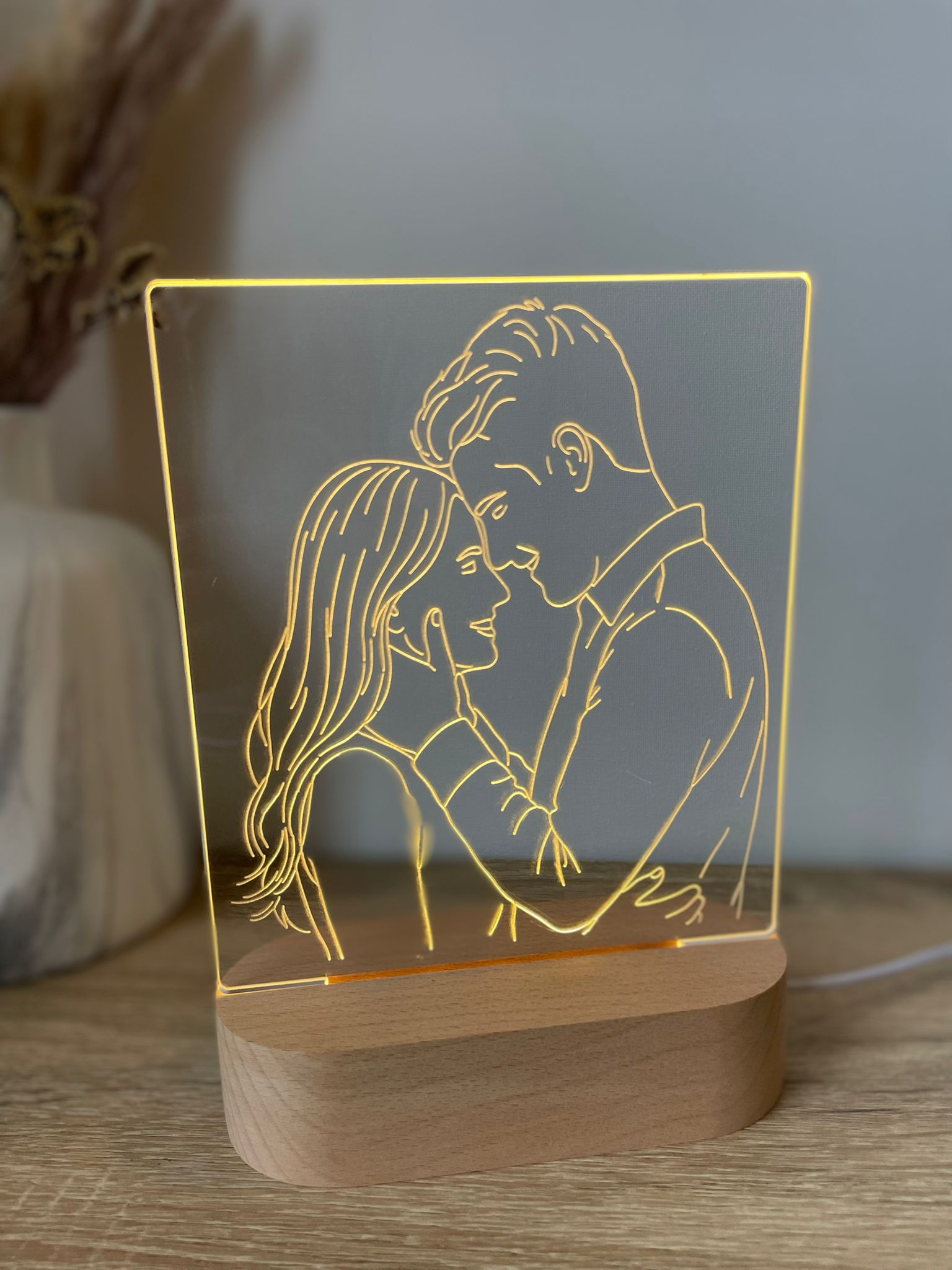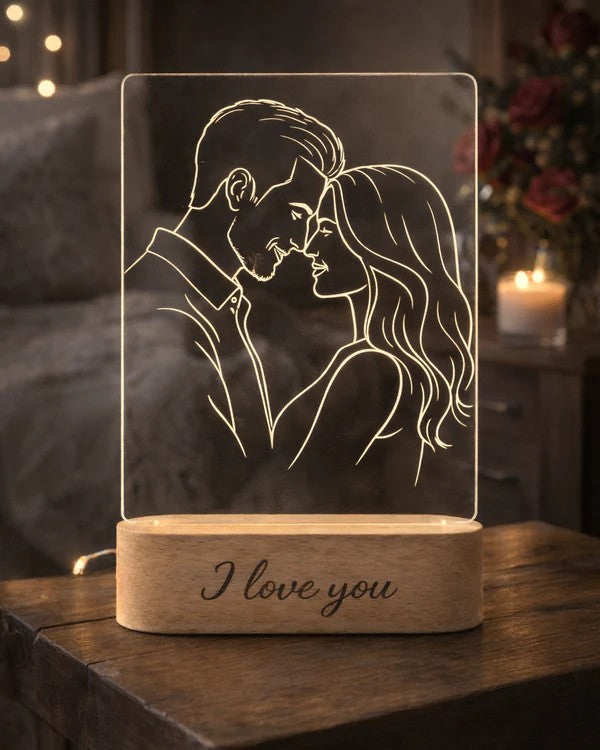
The best photo composition for line-art engraving depends less on the number of people and more on how clearly the main subjects can be separated, recognised and arranged within the final design.
A close portrait of one person usually gives the most detail. A couple photo works best when both faces are visible and close together. A family photo can work when the group is compact and every important face remains large enough to see. For a baby, choose a simple image with a clear face, profile or recognisable pose rather than a distant scene filled with blankets, furniture or background detail.
This guide compares one-person, couple, family, parent-and-baby and baby-only compositions so you can choose a photograph that can be transformed into clean, balanced line art for an AuraLine™ Line Art Lamp or StoryFrame™ Framed Line Art Lamp.
Which Photo Composition Usually Works Best?
- One person: usually the clearest option for facial features, hairstyle, profile and clothing details.
- Couple: an excellent choice when both people are close together, similarly lit and not covering each other’s faces.
- Family: suitable when the group is compact and the faces are still large, sharp and clearly separated.
- Baby only: strongest when the baby’s face, profile, hands or characteristic sleeping pose is easy to recognise.
- Parent and baby: often works very well because the relationship is visible without creating a crowded composition.
One or two main subjects normally create the cleanest and most recognisable result. More people can be included, but every additional face reduces the space available for individual detail. The important question is not simply “How many people are in the photo?” but “Can each important person still be identified when the image is simplified into lines?”
Why Composition Matters More Than the Original Setting
Line art does not reproduce every colour, texture and background object from a photograph. It keeps the outlines and defining details that make the people or moment recognisable. This means a technically beautiful image can still be a weak choice if the subjects are distant, overlapping or surrounded by visual clutter.
A useful composition gives the main subjects visual priority. Their faces and body outlines should be easy to distinguish from each other and from the background. Hair, shoulders, hands, clothing edges and profile lines should not disappear into deep shadow or merge with another person.
The strongest photograph is therefore not always the most formal one. A simple phone photo can be more suitable than a professional group portrait when the people are closer, more naturally positioned and easier to recognise.
One Person: Best for Detail and a Strong Focal Point
A one-person portrait gives the artwork one clear subject. Because the available design space is not divided between several people, more attention can be given to the face, profile, hairstyle, clothing outline or characteristic pose.
Choose a one-person photo when:
- the gift is centred on one parent, grandparent, child, partner or friend;
- the person’s expression or profile is the most meaningful part of the image;
- you want a clean memorial portrait;
- the original photo has a strong silhouette or recognisable pose;
- you prefer a minimal composition with one obvious focal point.
What makes the composition work?
The person should fill a useful part of the frame without important features being cut off. A head-and-shoulders portrait is often effective because the face remains large, while enough of the shoulders and hair are visible to create a complete outline. A side profile can also work well when the forehead, nose, lips and chin are clearly separated from the background.
Avoid choosing a photograph in which the person is a small figure inside a large landscape. Cropping may help, but it cannot restore facial detail that was never captured clearly.
Couple: Best When Both People Form One Connected Shape
Couple photographs are especially suitable for wedding, engagement and anniversary keepsakes because the relationship is immediately visible. The strongest composition usually places both people at a similar distance from the camera, with their faces clearly shown and their bodies naturally connected.
Choose a couple photo with:
- both faces in focus;
- similar lighting across both people;
- heads positioned reasonably close together;
- a natural connection such as holding hands, leaning together or facing each other;
- clear separation between hair, clothing and the background.
A wedding portrait can work very well, but check whether a veil, bouquet, hat, hand or deep shadow covers an important part of either face. Small overlaps can be manageable. Heavy overlap, however, may make one person visually secondary or difficult to identify after simplification.
When one person stands much closer to the camera than the other, the composition can feel unbalanced. A more even distance usually produces a calmer result in which both people receive appropriate visual weight.
Family: Keep the Group Compact and the Faces Large
A family photograph can become meaningful line art, particularly for parents and grandparents. The challenge is not the idea of a family group; it is the amount of detail that must fit into one composition.
A compact family of three or four may work well when everyone is close together and clearly visible. A large group photographed from far away is less suitable because the faces become small and the design must choose between preserving the group arrangement and preserving individual features.
A family photo is more likely to work when:
- the family fills most of the image;
- each face is sharp and visible;
- people are arranged in one compact group rather than spread across the frame;
- heads do not heavily overlap;
- the background is simple or can be excluded from the artwork;
- there is one clear family moment rather than several competing actions.
What should you avoid?
- large reunion or wedding-group photographs with many small faces;
- rows of people standing far from the camera;
- images in which someone is hidden behind another person;
- busy indoor scenes where furniture and clothing patterns merge with the group;
- screenshots from social media that have already lost image quality.
When choosing between two family photos, select the image with the clearest faces and strongest group shape, even if the other photograph has a more impressive location. The people are the subject; the setting is secondary.
Baby Only: Choose Recognition Over Decoration
Baby photographs often contain blankets, toys, baskets, nursery furniture and decorative props. These details may look appealing in the original image, but they can compete with the baby when the photograph is converted into line art.
The best baby composition makes the child easy to recognise through the face, sleeping profile, hands, feet or curled body position. A close sleeping portrait, a calm side profile or a simple image of the baby lying against a plain blanket can all work well.
Choose a baby photo with:
- a clearly visible face or profile;
- soft, even lighting;
- open visibility around the head and body;
- a simple blanket or calm background;
- little motion blur;
- a pose that is meaningful to the family.
Do not reject an image merely because the baby is not looking at the camera. A sleeping profile or downward gaze may create a more recognisable and emotionally natural outline than a front-facing image with harsh flash or deep shadow.
Parent and Baby: A Strong Balance of Person and Relationship
A parent-and-baby photograph is often one of the strongest choices because it shows both identity and relationship without becoming a large group composition. The embrace, gaze or position of the hands can communicate the connection even after unnecessary background detail is removed.
Choose an image in which the baby’s face is not completely hidden against the parent’s chest or shoulder. The parent’s face should also remain visible enough to form a recognisable outline. Side-by-side faces, a forehead touch, a seated cuddle or a parent holding the baby slightly away from the body can all create clear line-art compositions.
If the photograph includes both parents and a baby, keep the same rule: the three faces should remain large enough to see, and the group should form one compact shape. A close family-of-three portrait usually works better than a full-room lifestyle image.
Should You Choose a Close-Up or a Full-Body Photo?
A close-up normally preserves more facial detail. A full-body image shows posture, clothing and interaction, but only works when the people still occupy enough of the frame.
- Choose a close-up when recognition depends on facial features, expression, hairstyle or profile.
- Choose a half-body composition when hands, an embrace, a bouquet, a baby or another meaningful interaction matters.
- Choose a full-body composition only when the pose or silhouette is central and the subjects are still sharp and sufficiently large.
For couples and parent-and-baby photographs, a half-body crop often creates the best balance. It keeps the faces visible while preserving the gesture that explains the relationship.
How Much Space Should Be Around the Subjects?
Some space around the people helps prevent hair, shoulders and clothing from being cut off, but excessive empty space makes the subjects smaller. The ideal image gives enough room for a clean crop without turning the people into distant figures.
Check the outer edges of the photograph. Important hair, hands, ears, feet, veils or shoulders should not be cut off unintentionally. A deliberate crop can look strong; an accidental crop often makes the finished composition feel incomplete.
Also check the space between people. When two dark hairstyles, jackets or shoulders merge into one area, it may be harder to preserve both individual outlines. Clear separation or lighter contrast usually helps.
Which Format Suits the Composition?
AuraLine™ uses a compact freestanding acrylic panel and works especially well for a single person, a couple, a parent and baby, or another composition with one or two main subjects.
StoryFrame™ uses a larger 23 × 17 cm framed acrylic format. It can provide more room for a family, baby-and-parent composition or wider portrait, although the same rule still applies: clear, visible subjects matter more than the number of people.
Both products transform a real photograph into clean line art, send a digital Design Proof before engraving and are made to order in AtaNova’s Antwerp atelier. The estimated total delivery time is 3–5 business days from the order date, with production included within that estimate. Browse the Personalised LED Lamps collection to compare the available formats.
Final Photo Composition Checklist
- Can every important face be recognised at normal viewing size?
- Are the subjects sharp and evenly lit?
- Do the people fill a useful part of the frame?
- Are faces, hair and body outlines clearly separated?
- Is anyone hidden, heavily cropped or much farther from the camera?
- Does the image show one clear relationship or moment?
- Can most background objects be ignored without changing the meaning?
- Is this the best-quality original file rather than a compressed screenshot?
Choose the photograph in which the people are easiest to recognise and the relationship is easiest to understand. A simple, close and emotionally clear image usually becomes stronger line art than a visually complicated photograph with more scenery, more people or more decoration.
Frequently Asked Questions
Is one person or two people better for line-art engraving?
Both can work very well. One person allows more room for facial and profile detail, while two people can create a strong relationship-based composition. The best result comes from clear, well-lit subjects that are close enough to remain recognisable.
Can a family photo be turned into line art?
Yes, when the family forms a compact group and every important face is sharp, visible and large enough to see. Large group photographs with many small faces are less suitable because individual details may be lost.
What is the best baby photo for line-art engraving?
Choose a clear baby portrait with soft lighting, a visible face or profile and a simple background. Sleeping poses, parent-and-baby portraits and close images on a plain blanket can all work well.
Can three or four people be included?
Yes, provided the group is photographed closely and the faces remain clearly visible. A compact family composition is usually stronger than a distant full-body group or a wide scene with a busy background.
Should everyone look at the camera?
No. Side profiles, natural interaction and people looking at each other can produce strong line art. What matters is that the important facial outlines and relationship remain clear.
Is a close-up better than a full-body photo?
A close-up usually preserves more facial detail. A half-body or full-body photo can work when the pose, hands or interaction matters and the subjects still fill enough of the frame.
What happens if the composition is not suitable?
AtaNova reviews the uploaded photograph before production. If the image is too distant, blurry, dark or crowded for a clean result, we will contact you before engraving and discuss a better photo or the best available solution.
Will I see the composition before engraving?
Yes. A digital Design Proof is sent by email before engraving. Check the crop, balance, faces, outlines and any selected wording before approving the design.